CASE STUDY
Self-Service Check-In & Baggage Journey
Designing a self-service check-in and baggage journey that builds confidence, reduces stress, and supports both passengers and staff at a medium-to-large international airport.
Business Context and Problem
Travel should be effortless and empowering for everyone. Airports and airlines are expanding self-service check-in and Auto Bag Drop to make journeys smoother, faster, and more enjoyable for passengers and staff alike.
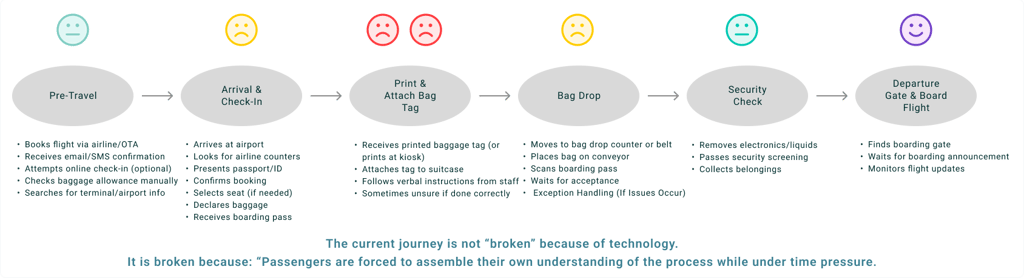
Yet adoption isn't universal. Travelers sometimes feel uncertain, and the process can break down between check-in, bag tagging, and bag drop. Recovery from edge cases — like overweight bags or tagging issues — can be unclear, and the transition from self-service to assisted service isn't always seamless.
Design brief: A journey that builds confidence, reduces stress, and supports both passengers and staff at scale.
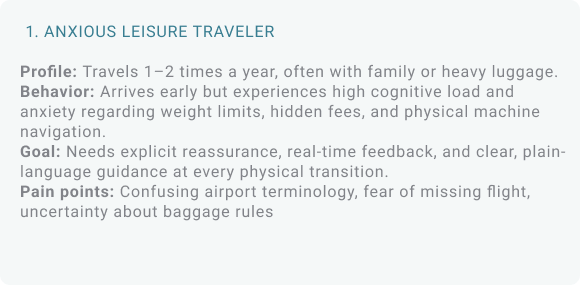
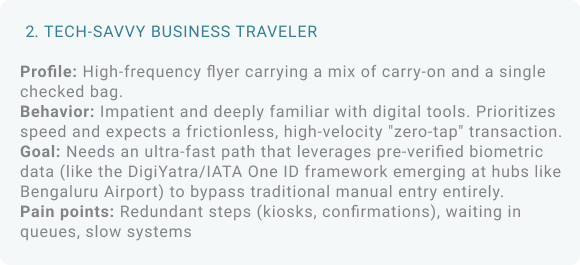
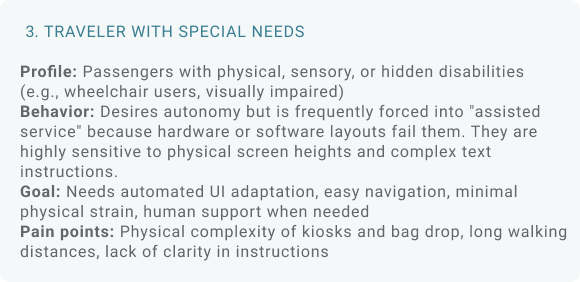
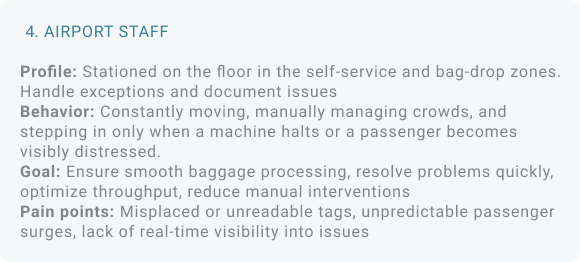
Target User Archetypes & Ecosystem Roles
Current Passenger Journey Map (As-Is State)
Problem Statement
International airport check-in remains stressful because passengers must navigate multiple disconnected touchpoints:
Flight check-in
Document verification
Baggage tagging
Bag drop
Security preparation
Passengers are often uncertain about:
What to do next
Whether they have completed a step correctly
Where to go if something goes wrong
At the same time, airport staff spend significant time resolving repetitive issues such as:
Overweight baggage
Passport/document questions
Incorrect bag tagging
Wayfinding assistance


Four Design Principles
Confidence Over Speed
Every step should answer 'Am I doing this right?' before the next action is required.
Visible Progress
Passengers always know where they are in the journey and what comes next.
Graceful Recovery
Edge cases — overweight bags, tagging errors, document issues — feel like guided detours, not dead ends.
Seamless Handover
The shift from self-service to staff assistance preserves context and never restarts the journey.
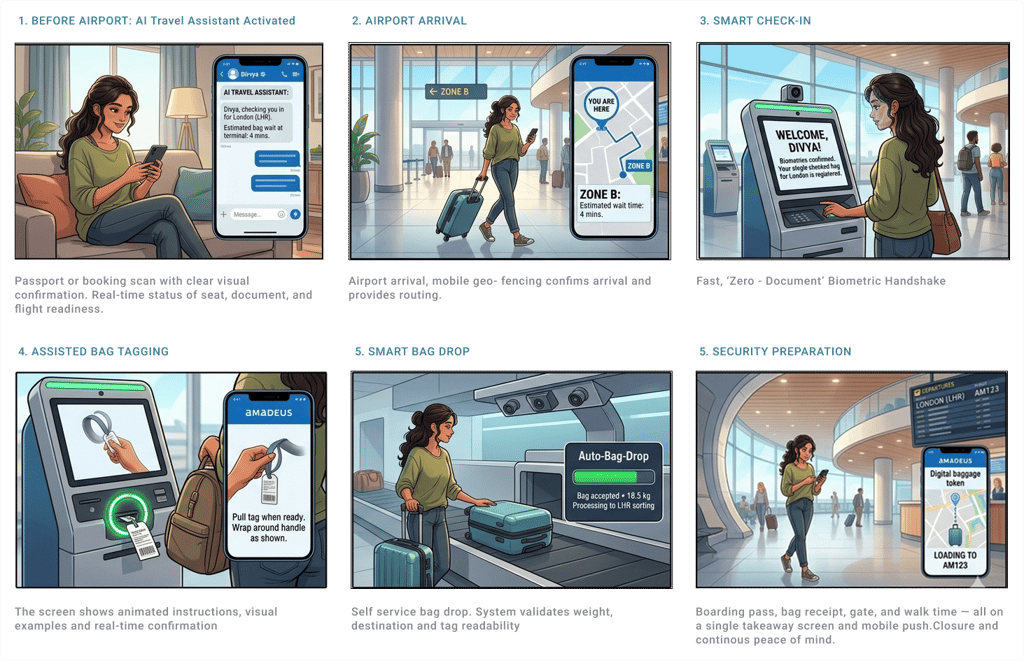
Proposed Journey
Edge Cases & Recovery Design
Most stress in self-service comes from exceptions. A self-service ecosystem is defined by how gracefully it handles exceptions. The goal is to move away from rigid error screens and pivot directly into guided recovery.
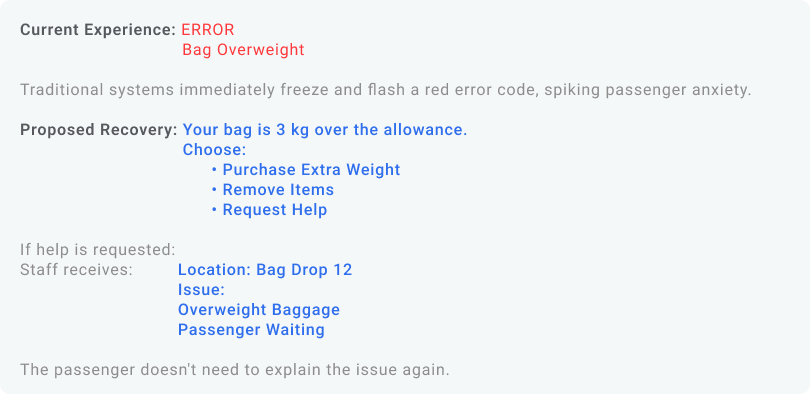
1. OVERWEIGHT BAGGAGE
Clear visual indicator, plain-language explanation, and one-tap option to repack, pay excess, or call staff — without losing progress.

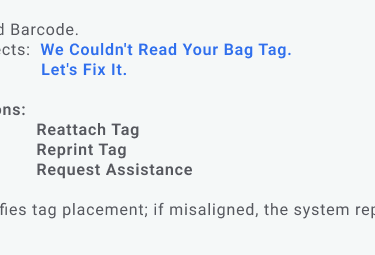
2. BAG TAG MISAPPLIED
The passenger applied the tag loosely, causing the barcode to twist face-down onto the conveyor belt out of the line of sight of the omnidirectional laser array.

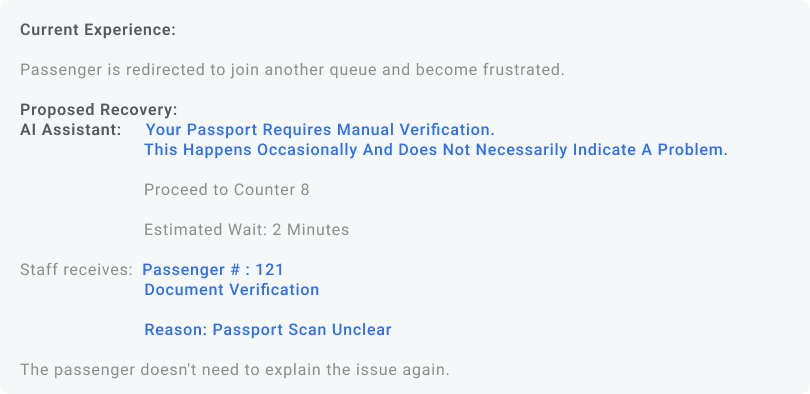
3. PASSPORT VERIFICATIOM FAILURE
Passenger is routed to a nearby staff with their session and data already transferred — no re-scanning required.
If the scanning system fails a second time, a prominent "Request Assistance" button illuminates. The staff receives a specific alert on their tablet: “Bag Tag 12: Tag scanning failure.” The staff can walk up, scan the tag using their handheld tablet camera, and send a wireless bypass command to the conveyor system without making the passenger change queues.
Success Criteria
Measurable targets aligned with passenger confidence, operational efficiency, and staff effectiveness.
PASSENGER KPIs
Reduced check-in completion time
Reduced confusion and abandonment
Increased self-service adoption
Increased passenger confidence
OPERATIONAL KPIs
Reduced queue lengths
Reduced staff workload
Faster bag-drop throughput
Higher first-time success rate
STAFF KPIs
Faster exception resolution
Better visibility into passenger issues
Fewer repetitive support interactions
AI-Assisted Guidance Concept
An ambient assistant — not a chatbot — that quietly observes the journey and steps in only when it adds value. It coaches passengers, validates documents, and equips staff with context.
AI Travel Companion
A context-aware assistant available via:
Airport App
Kiosk
QR code scan
Proactive Coaching
Detects hesitation (dwell time, repeated taps) and offers a plain-language tip or short demo before the passenger asks. "Next, place your suitcase on the conveyor."
Conversational Help
Voice + text assistant answers 'Can I bring this in my carry-on?' or 'Why is my bag too heavy?' in the passenger's preferred language.
Document Intelligence
Vision model pre-validates passport, visa, and booking match — flagging issues at scan time, not at the gate.
Smart Triage
Predicts which sessions are likely to need a human and silently pre-alerts the nearest roaming staff with full context.
Graceful Escalation
When the AI assistant can't resolve a request, it summarizes the situation for staff in one sentence — no repeated questions for the passenger.
Key UX Trade-offs & Rationale
Designing for complex public infrastructures requires balancing conflicting constraints and costs
Confidence over raw speed
Adding a one-second 'Done — here's what's next' confirmation slows power users slightly, but cuts abandonment and call-overs from infrequent flyers far more.
Trade-off
❌ Slight delay for expert users
✔ Major reduction in confusion-driven errors and staff interventions


Camera-verified tag placement vs. trust-the-passenger
Vision check adds hardware cost and a 2–3s step, but removes the most common downstream failure (misapplied tag) that costs minutes of staff time per incident.
Trade-off
❌ Higher infrastructure cost + slight processing delay
✔ Significant reduction in downstream baggage handling failures
AI assistant on-device prompts vs. opt-in chat only
Proactive nudges risk feeling intrusive, but pilot data showed silent hesitation is the strongest abandonment signal. We mitigate with a single dismissible coach mark, not a chat window.
Trade-off
❌ Perceived intrusiveness for some users
✔ Reduced drop-offs and hesitation-driven delays
Session portability vs. simpler architecture
Carrying state across kiosk, mobile, and agent tablet is a significant engineering investment, but it is the single biggest unlock for graceful recovery — and the core promise to passengers.
Trade-off
❌ Complex architecture and integration effort
✔ Unified experience across fragmented airport touchpoints
MVP Features
AI Check-In Assistant
Smart Bag-Drop Flow
Real-Time Bag Tracking
Staff Exception Dashboard
Validation Plan
Usability Testing
Test with 12 passenger across segments:
First-time travelers
International travelers
Frequent travelers
Special need travelers
Measure:
Task completion rate
Time to complete check-in
Error rate
Confidence score
Wireframes
AI Check-In Flow
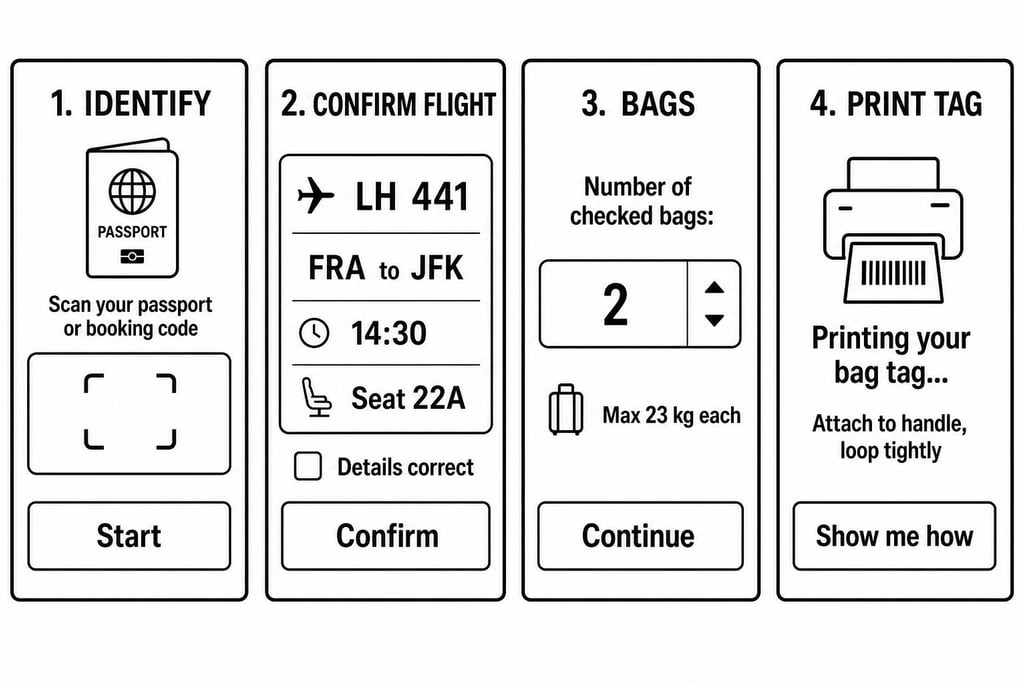
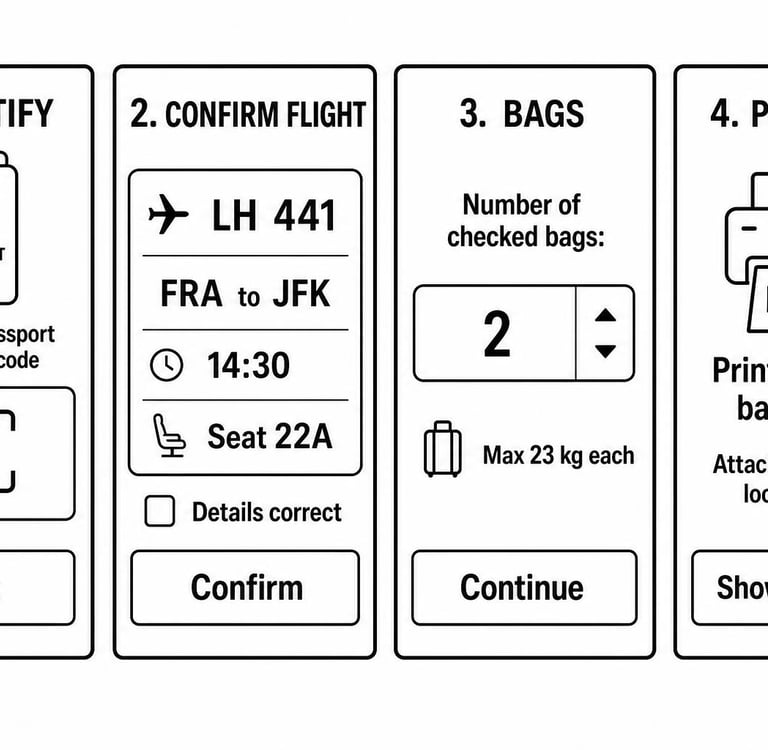
Bag Tag Attachment Guidance
Four-screen kiosk flow emphasizing a single primary action per screen, persistent progress, and plain-language confirmation at every step.
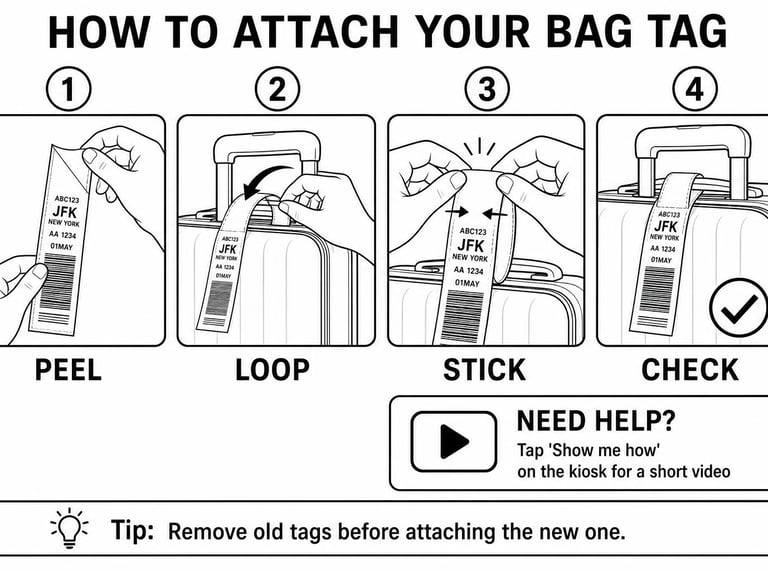
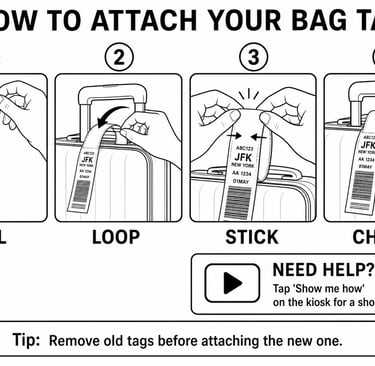
llustrated, step-by-step guidance for first-time users, paired with an on-kiosk "show me how" video and camera-verified placement before the passenger proceeds to Auto Bag Drop.
Future outcomes
For redesigning the experience for a large international airport, I would recommend:
Level 1 (Today):
Online check-in
Airport tag printing
Self-service bag drop
This approach balances convenience, baggage-handling reliability, and operational efficiency
Level 3 (Ideal Future):
Mobile-generated baggage QR code
Automatic tag printing at bag-drop stations
No separate check-in kiosk required
Level 2 (Near Future):
Home-printed tags for frequent travelers
© 2026 All rights reserved. Designed with purpose.
Divya HARIDAS